
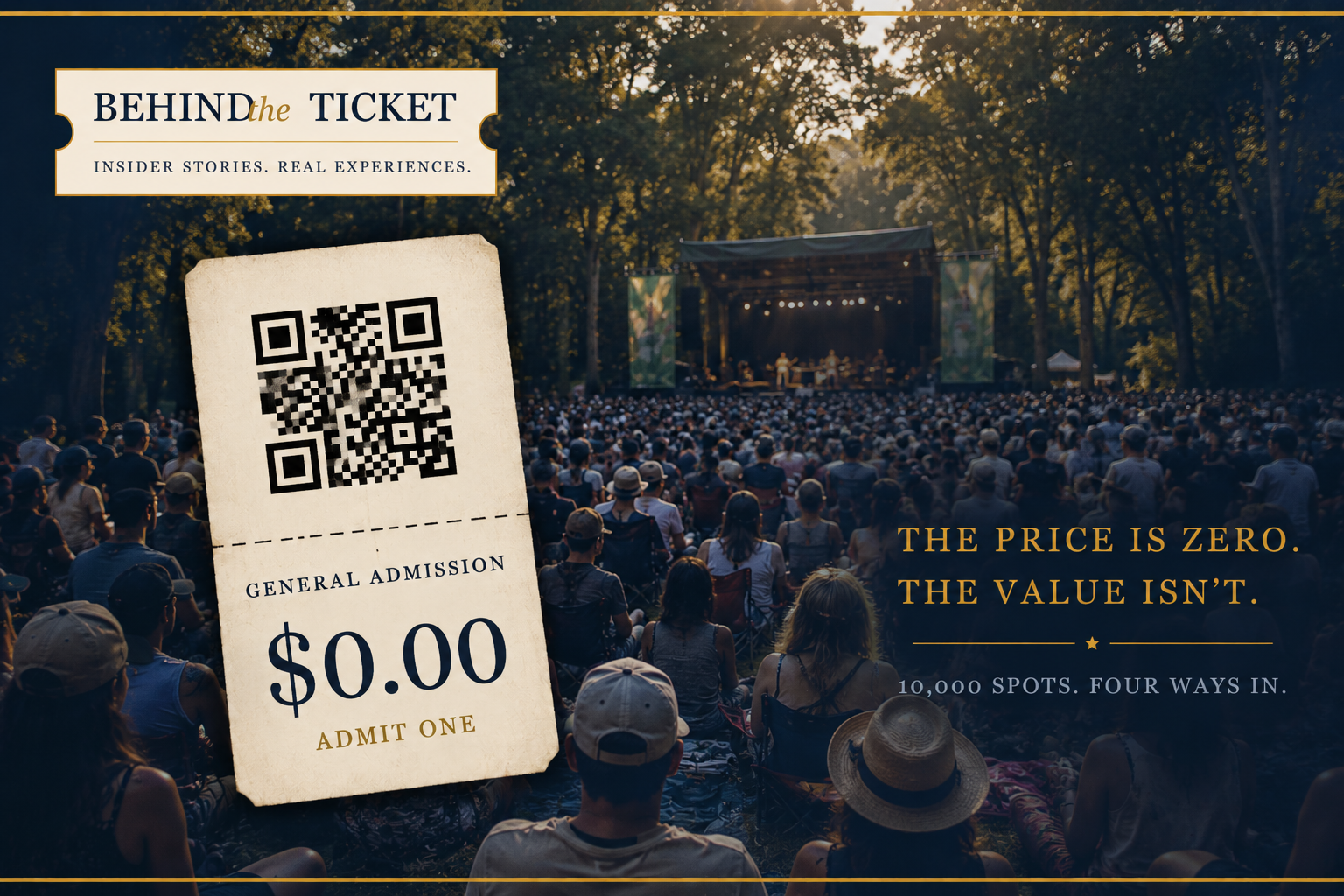
 Illustration: AI-generated composite. Not a photograph of Stern Grove.
Behind the Ticket: How Much Is a Free Ticket Really Worth?
This weekend, Public Enemy and Al Green play Stern Grove for free. But when demand is greater than capacity, even a $0 ticket has a story behind it. Behind the Ticket - There’s more to your ticket than the price printed on it.
FREE.
That’s a pretty good ticket price.
Especially when the names on the stage are Public Enemy and Al Green.
This weekend, both play Stern Grove’s Big Picnic Weekend in San Francisco — Public Enemy on Saturday, August 15, and Al Green on Sunday, August 16.
General admission is free.
But the Grove has a permitted capacity of 10,000.
And more people want to be there than can fit.
At the same time, Big Picnic Weekend offers premium experiences that cost thousands of dollars.
Same festival. Same Grove.
$0 at one end.
Thousands at the other.
I’ve spent many years in ticketing, and when I see that, I don’t see a contradiction.
I see a design.
Because the price printed on a ticket and the value of that ticket are not always the same thing.
And when demand exceeds capacity, even a free concert has to answer the same question every sold-out venue does:
Who gets in?
Stern Grove didn’t always need a complicated answer. For years, people could simply come to the Grove.
Then demand outgrew that model.
Today, getting thousands of people into a free concert involves lotteries, neighborhood box offices, QR codes, ticket transfers, volunteers, donors, premium experiences and a lot of decisions most people in the audience will never see.
That’s what I want to show you.
Let’s go Behind the Ticket.
When Free Becomes Scarce
This is where ticketing gets interesting.
Normally, price does some of the work.
There are only so many seats in a theater or spots in a venue. Demand goes up. Tickets sell. Eventually, the event sells out.
But what happens when the price is zero?
The demand is still there.
The capacity is still there.
The safety requirements are still there.
The only thing you removed was the price.
You still need a way to distribute something that has real value.
For Stern Grove, the answer isn’t one system.
It’s several.
1. The Lottery
The primary route to a free general-admission ticket is a lottery.
It isn’t about who has the fastest internet connection or who manages to click a button first.
For each concert, Stern Grove opens a separate lottery six weeks before the show. The lottery stays open for one full week, and each person can request up to four tickets.
Then the winners are selected randomly.
If you win, you have 72 hours to claim your tickets.
Don’t claim them?
They can go back into the pool and be released to someone else who entered.
Winning one concert doesn’t hurt your chances for another. Losing doesn’t improve them either. Each concert has its own lottery and everyone starts fresh.
Stern Grove also says demographic answers don’t affect your chances of winning. The information is collected in part because funders request it.
Those might sound like small details.
They aren’t.
One thing consumers rarely see is that how you distribute tickets is itself a decision about access.
You can reward speed.
You can reward loyalty.
You can sell to whoever is willing to pay the price.
You can hold inventory for members or donors.
Or you can put everyone into a lottery and let chance decide.
There’s no perfect system.
There are choices.
Stern Grove made theirs.
2. The Community Box Office
This might be my favorite part.
Not everybody lives online.
Not everybody wants to enter a digital lottery.
And not everybody who enters gets selected.
So Stern Grove created another path.
For each concert, 1,500 tickets — 15% of the Grove’s permitted capacity — are distributed through Community Box Offices around San Francisco.
You show up in person.
Tickets are distributed first come, first served, with a limit of two per person while supplies last.
Think about what that means.
Somebody made a deliberate decision to take a significant piece of inventory out of the primary online system and make it available another way.
That’s not just ticketing technology.
That’s access.
When you work around ticketing long enough, you realize decisions about inventory are rarely just numbers on a screen.
Those numbers can determine who gets an opportunity to be in the audience.
3. Pass It Along
You got tickets.
Something comes up.
You can’t go.
Stern Grove lets you give the ticket to somebody else.
Forward the PDF containing the unique QR code, and that person can use it for admission.
Simple.
But from a ticketing perspective, there’s something interesting happening there.
The person receiving the ticket doesn’t have to claim it. The ticket isn’t formally reassigned to a new name. Whoever has that valid QR code can use it.
In the ticketing world, there’s another way to handle that.
I work in ticketing software, which is why I notice this stuff.
I’ve worked with systems where the person receiving a transferred ticket has to claim it. Once they do, the ticket is formally reassigned to them.
Why does that matter?
Because now the organizer knows who actually has the ticket.
Say I receive four tickets and forward three of those QR codes to friends.
The organizer may still only have my contact information.
That sounds like a small thing.
Until something changes.
Weather moves in.
A start time changes.
There’s an important update before the event.
Now the organizer wants to communicate with everyone who is actually coming.
“How do we reach the people who actually have the tickets?” is a question that comes up all the time in my work.
And the answer can come down to something remarkably simple:
Did you ever ask the person holding the ticket who they are?
A registered transfer does that.
Stern Grove has chosen a simpler approach.
Forward the ticket.
Give your friend the QR code.
Let them go.
Neither approach is inherently right or wrong.
They’re designed to accomplish different things.
One reduces friction and makes sharing a free community ticket incredibly easy.
The other asks more of the recipient but gives the organizer more information in return.
Less friction or more information.
Both have value.
Behind that simple transfer is a choice somebody made about how the ticket should work.
4. Give Some Time, Get a Ticket
Volunteer.
Complete a full Stern Grove volunteer shift and you get two general-admission tickets to a future show of your choice. Stern Grove says it will try to accommodate your top choice, although popular shows aren’t guaranteed.
I like that.
Volunteer tickets are something I see in ticketing all the time.
Venues have volunteers, staff, sponsors, donors, artists and other groups who may receive access without going through the normal purchase process.
Every organization handles it a little differently.
Here, the proposition is simple:
Give some of your time.
Get two tickets.
Now we’ve gone from random selection...
to in-person distribution...
to transfer...
to participation.
Four different ways of thinking about access to essentially the same thing:
A free place inside the Grove.
There are other paths too, including ticket giveaways through community partners and sponsors.
The more you look, the more the word free starts to seem like the least interesting part of the ticket.
Free Admission Doesn’t Mean a Free Concert
Because here’s the other side of a $0 ticket.
The concert still costs money to produce.
Artists still perform.
Stages still get built.
Sound and lighting still have to work.
People still have to staff entrances, manage security, scan tickets, clean the venue and produce the event.
Stern Grove says the true cost of each concert is around $40 per person.
The person holding the free general-admission ticket just isn’t the one paying that $40 at checkout.
Someone else has to make the economics work.
And that’s where Big Picnic Weekend becomes especially interesting.
Alongside free general admission are premium donor experiences.
During the regular season, Stern Grove lists an individual Community Table seat at $200, a standard table for 10 at $2,000 and a premium table for 10 at $4,000. Stern Grove says pricing is higher during Big Picnic Weekend because of the additional production and hospitality.
The point is that one person can walk into the Grove with a ticket that cost $0 while someone else contributes thousands for a premium experience.
Same festival.
Same music.
Two very different transactions helping make the same weekend possible.
That isn’t a contradiction.
That’s the design.
The Ticket Is Still a Ticket
When most of us hear free concert, we tend to think the ticketing part disappeared.
It didn’t.
The money disappeared from one transaction.
The ticket didn’t.
It still controls access.
It still represents a place inside a venue with finite capacity.
It still has to get from the organization to the person attending.
It still has to be delivered, transferred, scanned and validated.
And somebody still has to design the rules around all of it.
Because ticketing isn’t just about selling tickets.
Sometimes there isn’t even a ticket to sell.
It’s about managing access to an experience people want to have.
And once thousands of people show up carrying those tickets, there’s another story waiting behind the gate:
What happens when all that technology suddenly doesn’t work?
We’ll save that one for another day.
For now, thousands of people are about to see Public Enemy and Al Green at Stern Grove with a general-admission ticket that cost them exactly $0.
Free ticket.
Real value.
And a whole lot happening behind it.
That’s what you find Behind the Ticket.
— Mike MacPherson SF Bay Weekend
SF Bay Weekend Newsletter
Love the stories behind Bay Area experiences?
Join the newsletter for Mike's weekly Top 10 and the subscriber-first story from wherever the weekend takes him.
Find the Magic.
More Behind The Ticket Stories
Boots on the Ground: When 12,000 People Show Up for Al Green
Gina was in line before the gates opened and still lost her usual spot. On her fourth trip to Stern Grove, she learned what “arrive early” really means.
 Past Story
Outside Lands 2026: Road Closures and 20 Things to Do Instead
Outside Lands returns to Golden Gate Park on Friday, August 7, and runs through Sunday, August 9. Charli xcx headlines Friday, The Strokes Saturday, RÜFÜS DU SOL Sunday. It's the festival's 18th year, and the SFMTA expects roughly 75,000 people a day. Three-day general admission, GA+ and VIP sold out months ago, and most single day tickets have gone since. Roughly 800,000 people live in San Francisco. About seven million live in the Bay Area. The overwhelming majority of them are not going to Outside Lands. If that's you, the festival is still going to happen to you. This guide covers what actually changes across the city, and we highlight twenty events happening between Thursday and Sunday that have nothing to do with the festival.
 Past Story
The Calendar Is the Collection
The Bay Area is running more immersive experiences than at any point in its history. Their economics couldn't be more different and the industry's first major bankruptcy explains why that matters.