
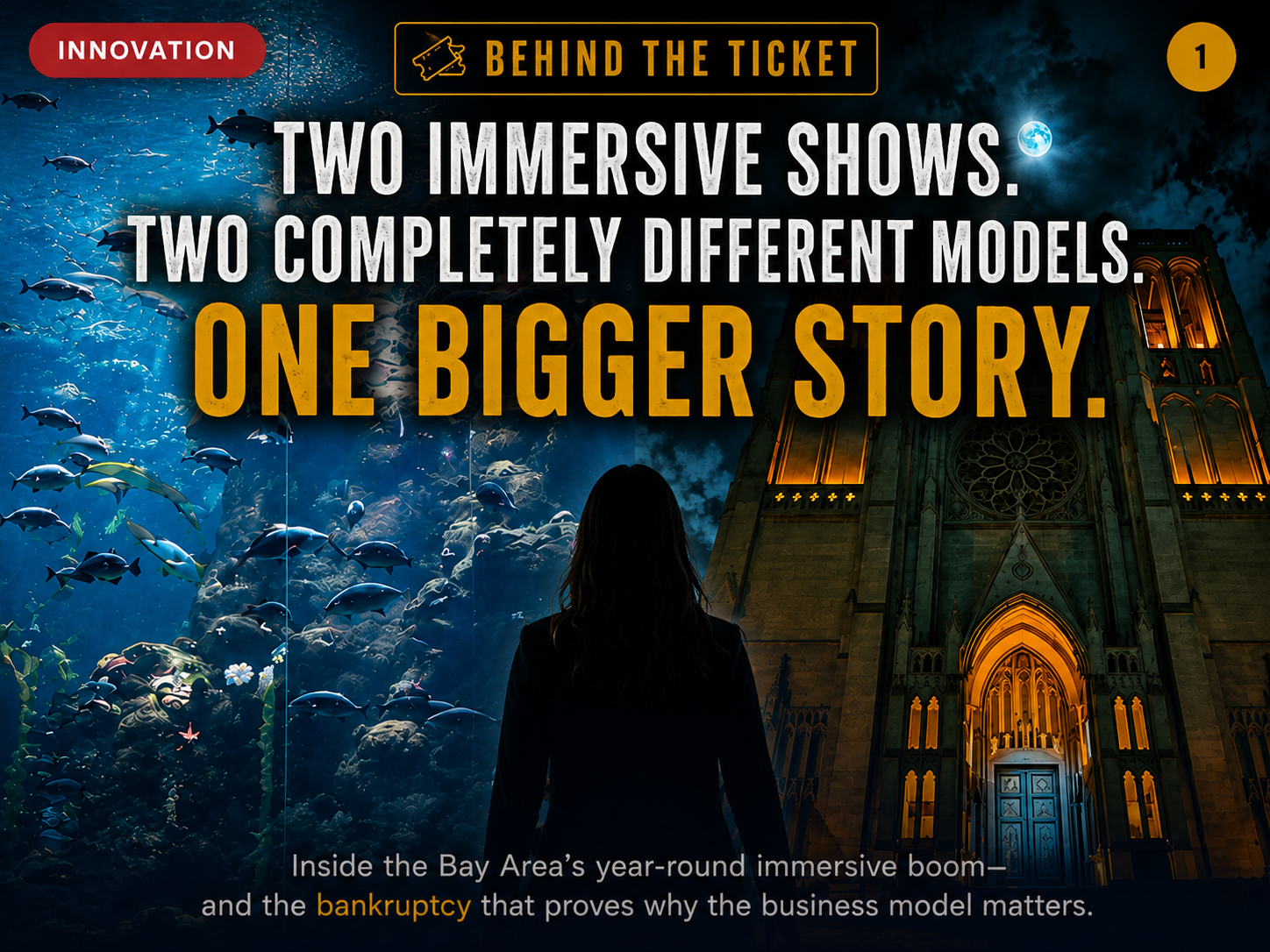
The Bay Area is running more immersive experiences than at any point in its history. Their economics couldn't be more different and the industry's first major bankruptcy explains why that matters.
On Nob Hill, Grace Cathedral is being taken apart and reassembled in light.
AURA, created by Montreal studio Moment Factory and co-presented by Fever, begins as an app guided walk through Grace Cathedral's history. It then unfolds into a 50 minute projection experience that transforms the cathedral into a journey through light, water, flora, the cosmos, and wildlife, All set to an original score.
The first immersive boom sold millions of tickets. It also ended in bankruptcy.
— By Mike MacPherson Behind the Ticket | SF Bay Weekend
It's the series' first American edition, following Montreal's Notre-Dame Basilica in 2017, Paris's Dôme des Invalides and Quebec City, 2.2 million visitors between them. San Francisco bought 30,000 plus tickets in the opening weeks; the run is booked through December 2026.
Four miles west, in Golden Gate Park, the California Academy of Sciences is doing something that looks similar and works nothing alike.
Vivid: Immerse Your Senses runs through September 6 in the Forum Gallery: six ecosystems built from high-resolution projection, spatial audio and diffused scent. An Amazon canopy, a bat cave rendered in echolocation, an underground realm of moles and ants, a prairie scaled to its insects. Greenland ice floes that seem to crack underfoot, and the depths where sperm whales sing to their calves.
Two shows, one city, one summer and two entirely different businesses. AURA is a standalone ticket, bought like a concert seat, its revenue keeping a landmark earning during hours it would otherwise sit dark. Vivid carries no upcharge: included with admission, free to members. One is a revenue center; the other a retention tool, engineered to give a member a reason to return in July.
Both are only the summer entries on a calendar that now runs twelve months.
A Year Measured in Nights
October brings the Autumn Lights Festival at the Gardens at Lake Merritt, a three-night fundraiser returning the 15th through the 17th. November is even busier. Oakland Zoo opens Glowfari with hundreds of illuminated animal lanterns along a mile-long walk through the grounds after regular closing hours. Running through late January, the proceeds are directed to the zoo’s operating expenses, like animal care, education and conservation.
San Francisco Botanical Garden will offer Lightscape the same month: a mile of trail, more than a million lights, fresh off a debut season and confirmed for winter 2026. Down the Peninsula, Filoli turns 16 acres of formal gardens into a night landscape of 350,000-plus lights, then fills the rest of the year with Thursday Summer Nights. And since March, the Bay Lights have run nightly on the Bay Bridge, dusk to dawn.
Then there is the weekly entry. Every Thursday, the Exploratorium closes to families at 5 p.m. and reopens an hour later as an adults only venue. After Dark, an 18 and over event, with drinks, a DJ, guest speakers and 650 odd interactive exhibits inside a building exclusively for adults only.
Viewed as individual events, this looks like a dozen institutions independently discovering the light bulb. Viewed as a calendar, it's a single strategy. Every program on that list exists to give a household a reason to return somewhere it has likely already been.
The Membership Machine
The Exploratorium sells the thesis in its purest form. It offers a dedicated After Dark membership: unlimited access to more than fifty Thursday evenings a year, pitched in the museum's own marketing as costing less than three tickets. That isn't an event added to a calendar, it's a recurring night turned into a product line with its own subscriber base. A science center selling a weekly social occasion the way a gym sells a membership. ABC7 reported after the move to Pier 15 that the program was pulling seven times the nighttime attendance of the old building.
The San Francisco Botanical Garden's pitch to prospective members is early access to Lightscape tickets before the good dates disappear. Oakland Zoo members get ten percent off Glowfari.
Halfway across the country Newfields, in Indianapolis, has built the concept out the furthest: memberships that are roughly $55 offer discounted early access to four seasonal events, so any household attending three events is better off with a membership rather than paying for any one single event at the gate. The collection is no longer the product. The calendar is.
The Number Nobody Quotes
It has not all been a bed of roses leading to easy money. The sharpest evidence comes from the country's most closely studied immersive installation.In July 2021, the Indianapolis Museum of Art at Newfields turned its entire fourth floor over to the Australian company Grande Experiences. Which led to the birth of THE LUME Indianapolis, a roughly 30,000 square foot, 120 projector experience that opened with Van Gogh Alive and was a sensational success drawing 235,000 visitors before closing in May 2022, a record for the century old institution. That figure appears in nearly every article written about the immersive boom. The one after it almost never does.
Monet & Friends Alive, the sequel to Van Gogh Alive which was held in the same room, drew roughly 120,000 visitors over eleven months, a 51 percent drop from the Van Gogh attendance, according to numbers Newfields' vice president of marketing gave the Indianapolis Business Journal. Same space, same technology, same city, half the demand.
Both figures are the story: this programming can deliver attendance a conventional exhibition cannot approach, and shed half of it in a single content cycle. No Bay Area institution has published a comparable number. Someone should.
What Happened to Van Gogh
The boom has already had its correction. The industry rarely brings that up. Lighthouse Immersive, the Toronto company behind Immersive Van Gogh, the production that launched the genre in North America and earned a cameo in Emily in Paris filed for Chapter 15 bankruptcy in Delaware in July 2023. Its website had claimed more than seven million tickets across some twenty North American cities. A month earlier, it had to cancel announced runs in both Houston and Atlanta.
The problem was never that audiences stopped liking Van Gogh. Media coverage at the time pointed to saturation: rival productions working the same markets simultaneously, with ticket buyers occasionally unable to tell which show they'd actually bought. The roughly $35 tickets looked like a dependable margin, right up to the moment there were too many of them.
That explains why the Bay Area's roster looks so different. Touring content is a commodity which is licensable by anyone, stageable anywhere, duplicable across town inside a season. What can't be duplicated is the landmark it's staged in and the relationship the institution already holds with its community. Grace Cathedral faces no rival Gothic cathedral on Nob Hill. The Exploratorium licenses nothing; After Dark is an after hours event at the Exploratorium with a DJ and a bar. Oakland Zoo's lanterns are generic; the mile of zoo they're strung through is not.
The Bill Comes Due
There's a cost question the celebratory coverage skips, and the Bay Bridge in San Francisco has just answered that question.
The Bay Lights on the Bay Bridge debuted in 2013 with 25,000 LEDs along 1.8 miles of the western span. They ran close to a decade before going dark in March 2023, when wind, salt air, moisture and vibration produced widespread system failures. Rather than patch it, organizers decided to rebuild outright, it relit on March 20 of this year with 48,000 custom engineered LEDs built for a marine environment, at a cost of $11 million, raised entirely from private philanthropy and more than 1,300 contributors, with no public money.
Ten years of operation, an eight figure replacement, and a fundraising campaign to cover it. That is the actual lifecycle of a permanent light installation. That is the line item missing from most board presentations. THE LUME rotates its content annually while its infrastructure gets described as permanent but projectors have service lives, and 120 of them come due at once.
Costs move on shorter horizons too. Oakland Zoo CEO Nik Dehejia told KTVU that tariffs hit Glowfari's imported lanterns this season, raising the price of mounting the event. He brought them in regardless. Not every institution running a light festival on thin margins will have that luxury next year.
The Saturday Night Problem
The most useful reframe here has nothing to do with technology.
Cultural institutions no longer primarily compete with just one another. A Saturday evening at a Bay Area museum has to also compete with streaming, gaming, a Mission district dinner reservation, a Warriors game, or a drive to Point Reyes. Nearly all are cheaper, with most requiring no planning. Against that field, having an excellent permanent collection persuades nobody who is deciding at 4 p.m on a Saturday night, what to do at seven.
What this experience programming buys is a reason to be chosen on a particular night, which is why almost all of it happens after dark and attaches to a season.
These are now scheduling products as much as artistic ones.
It's also why technology matters least. Stained glass taught scripture to congregations who couldn't read. The film industry restructured how audiences absorbed narrative. Audio guides changed the pace of an art gallery tour. Projection mapping, spatial sound and diffused scent are the current tools, and they'll be superseded like everything before them. The shows that work are the ones visitors leave discussing what they saw rather than how it was done.
Does Any of This Convert?
Attendance numbers are abundant and easy to publicize. What's scarce is evidence about whether these audiences become members, donors or repeat visitors to the permanent collection, or whether they're a distinct one-time market that walks in, looks up and never returns. The Exploratorium's After Dark membership suggests at least one institution has found a segment worth subscribing to. Whether a Glowfari ticket buyer ever comes back to see the animals in daylight is not a number anyone publishes.
Until institutions start reporting it, the honest position is that this programming is a proven attendance tool but an unproven audience development one. For the Bay Area institutions building their calendars around immersive experiences, success won't be measured by how many people show up this weekend.
It will be measured by how many come back after the lights go out.
_______________________________________________________________________________________ The Bay Area Immersive Calendar
Now running
AURA - Grace Cathedral, 1100 California St. Roughly 50 minutes, seated, all ages; ticketed through Fever. Through December 2026. Nob Hill parking is scarce; the 1 California bus and the California Street cable car both stop at the foot of the Great Steps.
Vivid: Immerse Your Senses - California Academy of Sciences, Forum Gallery, Golden Gate Park. Daily through September 6. Included with admission, free for members. Sensory advisory: dark spaces, flashing lights, diffused scents.
After Dark - Exploratorium, Pier 15. Thursdays, 6–10 p.m., 18+. A separate After Dark membership covers the full year. The Bay Lights - Bay Bridge western span. Nightly, dusk to dawn. Free. Best viewed from the Embarcadero between Pier 14 and Brannan Street Wharf.
Summer Nights - Filoli, Woodside. Thursday evenings.
Planned for this fall and winter
Autumn Lights Festival - Gardens at Lake Merritt, Oakland. October 15–17.
Glowfari - Oakland Zoo. Opens November, runs to late January. Dynamic pricing, members save 10%, parking included.
Lightscape - San Francisco Botanical Garden. Returns winter 2026; tickets typically released in late summer, members first. Holiday Lights - Filoli, Woodside. Opens late November.
Behind The Ticket examines the trends reshaping how audiences experience culture and the institutions that host it.
SF Bay Weekend Newsletter
Love the stories behind Bay Area experiences?
Join the newsletter for Mike's weekly Top 10 and the subscriber-first story from wherever the weekend takes him.
Find the Magic.
More Behind The Ticket Stories
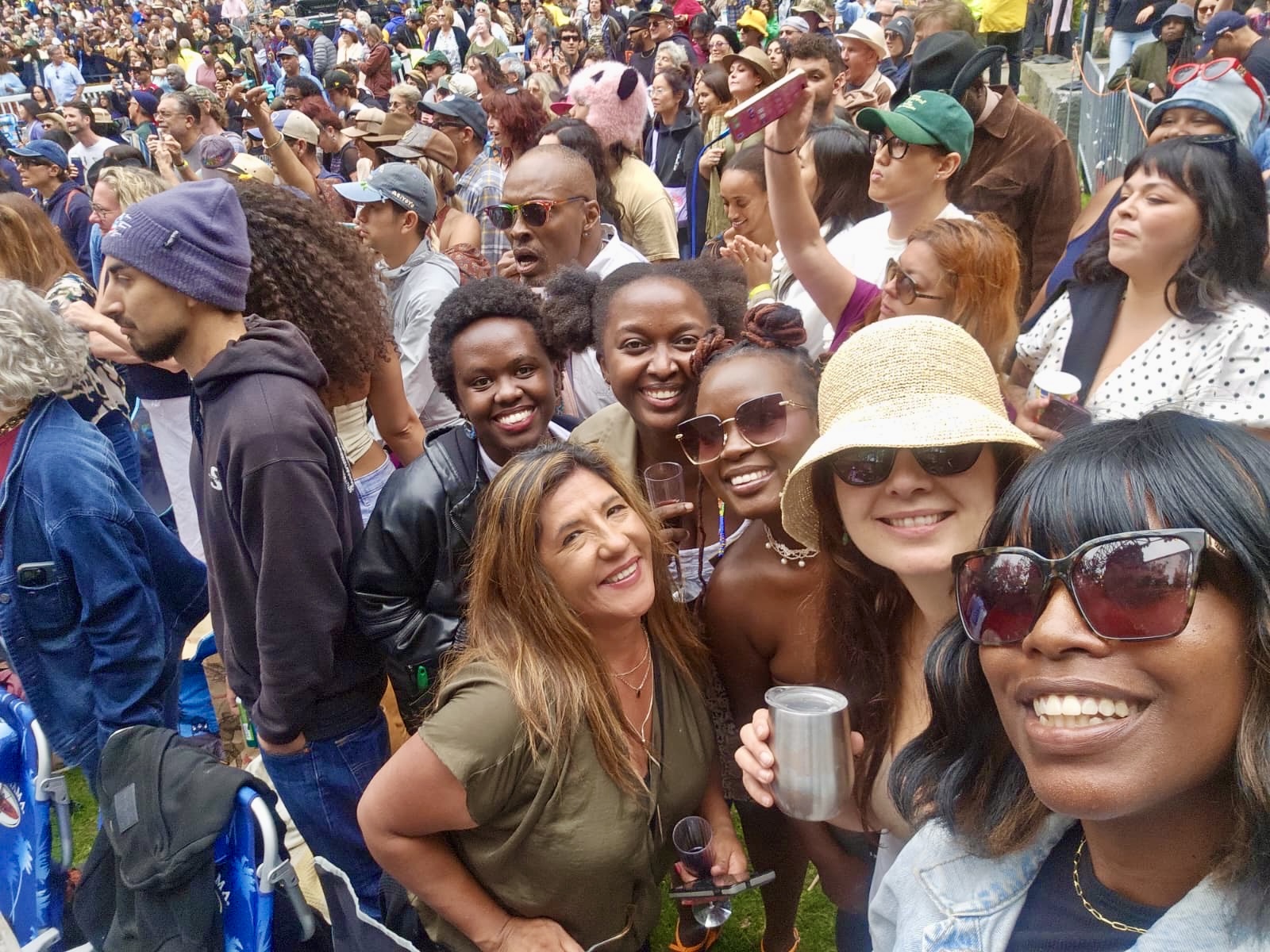
Boots on the Ground: When 12,000 People Show Up for Al Green
Gina was in line before the gates opened and still lost her usual spot. On her fourth trip to Stern Grove, she learned what “arrive early” really means.
Behind the Ticket: How Much Is a Free Ticket Really Worth?
This weekend, Public Enemy and Al Green play Stern Grove for free. But when demand is greater than capacity, even a $0 ticket has a story behind it. Behind the Ticket - There’s more to your ticket than the price printed on it.
 Past Story
Outside Lands 2026: Road Closures and 20 Things to Do Instead
Outside Lands returns to Golden Gate Park on Friday, August 7, and runs through Sunday, August 9. Charli xcx headlines Friday, The Strokes Saturday, RÜFÜS DU SOL Sunday. It's the festival's 18th year, and the SFMTA expects roughly 75,000 people a day. Three-day general admission, GA+ and VIP sold out months ago, and most single day tickets have gone since. Roughly 800,000 people live in San Francisco. About seven million live in the Bay Area. The overwhelming majority of them are not going to Outside Lands. If that's you, the festival is still going to happen to you. This guide covers what actually changes across the city, and we highlight twenty events happening between Thursday and Sunday that have nothing to do with the festival.